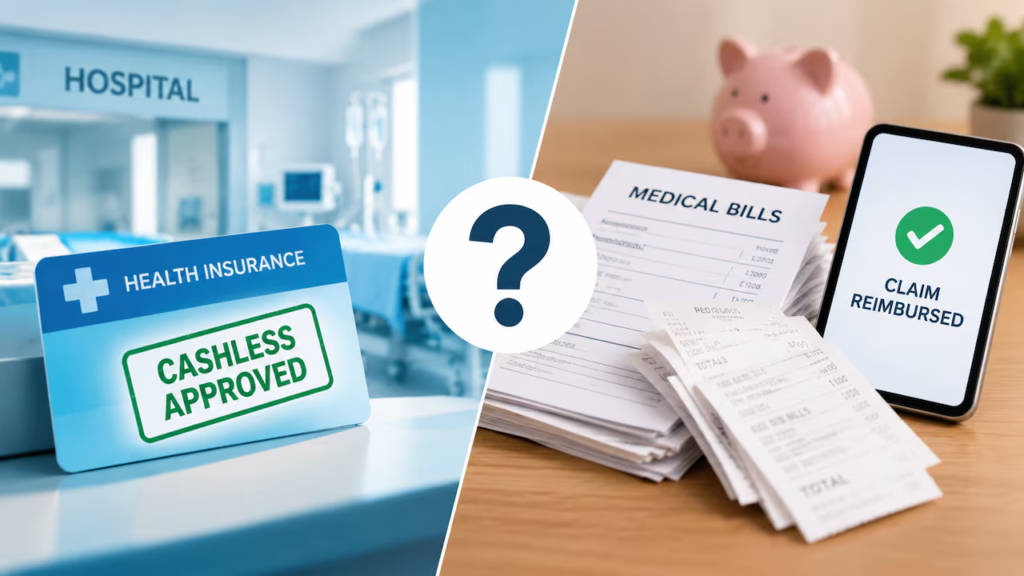
Cashless health insurance claims allow policyholders to receive covered medical treatment at a network hospital without paying the entire eligible hospital bill upfront. Instead, the insurer or its authorised claims administrator settles the approved amount directly with the hospital, subject to the policy terms, limits and exclusions.
Cashless treatment can make hospitalisation financially easier, but it does not necessarily mean that every expense is completely free.
What Is a Cashless Health Insurance Claim?
Under a cashless arrangement, the hospital communicates with the insurance company or Third-Party Administrator (TPA) for approval of covered treatment. Once the claim is authorised, the insurer settles eligible expenses directly with the hospital.
The policyholder may still have to pay expenses that are not covered, such as deductibles, co-payments, excluded treatments, non-medical items or amounts exceeding applicable policy limits.
Also Read: Faiz Baloch Bio Age, Height, Career, Family, In 2026
How Does the Process Work?
1. Choose a Network Hospital
For planned treatment, check whether the hospital is part of your insurer’s current cashless network. Network lists can change, so verify the hospital’s status before admission.
For emergencies, go to an appropriate hospital immediately. Insurance formalities can generally be addressed after emergency care has begun.
2. Inform the Insurer
For planned hospitalisation, notify the insurer or TPA in advance according to the policy’s notification requirements. In an emergency, notification should be made as soon as reasonably possible.
The hospital’s insurance desk can often assist with the initial process.
3. Submit Pre-Authorisation
The hospital generally sends a pre-authorisation request containing information about the patient’s condition, proposed treatment and estimated expenses.
The insurer reviews the request against the policy terms and may approve, partially approve or request additional information.
4. Receive Treatment
After approval, treatment can proceed according to the hospital and insurer’s authorisation. Approval does not necessarily mean that every final expense will be covered.
If treatment costs change significantly, the hospital may need to request an enhancement of the approved amount.
5. Final Settlement
At discharge, the hospital prepares the final bill and sends relevant documents to the insurer or TPA. The insurer pays the eligible amount directly to the hospital.
The policyholder pays applicable non-covered expenses.
Documents Usually Required
Depending on the insurer and treatment, documents may include:
- Health insurance card or policy details
- Identity proof
- Doctor’s prescription and medical records
- Diagnostic reports
- Admission documents
- Pre-authorisation forms
- Final hospital bills
- Discharge summary
- Pharmacy or investigation bills, where applicable
The exact requirements vary according to the insurer, policy and type of treatment.
Why Can a Cashless Claim Be Rejected?
A cashless request may be declined for several reasons. The treatment may be excluded, the policy may not cover the particular condition, a waiting period may apply, the hospital may not be eligible under the relevant arrangement, or the requested expenses may fall outside the policy’s terms.
A rejected cashless request does not necessarily mean that the medical treatment itself cannot be received. Depending on the circumstances, the policyholder may be able to pay for treatment and subsequently submit a reimbursement claim if the policy permits it.
What Has Changed in 2026?
Health insurance processes in India have continued to become more digitally integrated, with insurers and hospitals increasingly using electronic communication for authorisation and claim processing. Policyholders should nevertheless check their individual policy documents because cashless arrangements, hospital networks and claim procedures can differ between insurers.
Before planned hospitalisation, verify the current network status, policy coverage, waiting periods, room-rent limits, co-payment, deductible and exclusions.
Tips for a Smoother Claim
Keep your policy details accessible, inform the insurer promptly, provide accurate medical information and retain copies of important documents. Before admission, ask the hospital’s insurance desk what amount may remain payable by you.
Most importantly, do not assume that “cashless” means “zero payment.” It generally means that the insurer directly settles eligible expenses with the network hospital, while you remain responsible for applicable non-covered costs.
Also Read: Know About Hair Growth Diet In 2026
Conclusion
Cashless health insurance claims can simplify hospitalisation by allowing eligible expenses to be settled directly between the insurer and network hospital. Understanding pre-authorisation, coverage limits, exclusions and personal payment responsibilities can help avoid surprises at discharge.
Always read your policy terms and confirm the latest claim procedure with your insurer before planned treatment.
This article is for general information only and is not financial, insurance or medical advice.
About the Author