When we think of terms like Artificial Intelligence, Deep Learning, or Neural Networks, we picture very complex systems in play. But many of these techs are founded on very basic principles. A great example is the perceptron.
Introduced by Frank Rosenblatt in 1957, the perceptron which at the time was a very early attempt at creating what, in biological neuron terms, was a very bio-inspired machine. Although it may not have been as complex as the networks we use today, the perceptron does in fact make it a great deal easier to understand modern machine learning.
What Exactly Is a Perceptron?
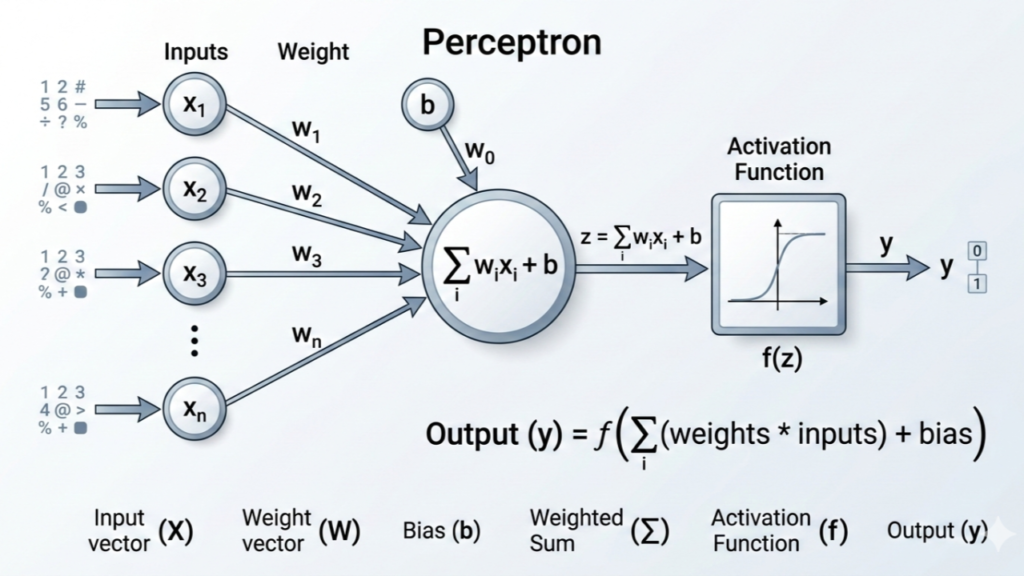
A perceptron is, in fact, a linear classification algorithm that we use to put data into two groups. For instance, it may determine which email is spam and which isn’t, if a certain product is included in an image or not, or if a transaction is to be marked as suspicious.
The model, which has multiple input variables, we put a weight for each of which, add a bias term, and output the output. The weights in this case represent the degree to which each feature plays a role in the decision.
For example, consider a basic perceptron that determines the outcome of a student’s exam. We may look at their attendance, study time, and past performance as input. The perceptron assigns a scale to each input and then totals them up for the result.
How Does a Perceptron Learn?
The fact is we do not have to determine the right weights by hand. The perceptron is able to learn them from examples.
During training, what the model does is put forth a prediction which it then compares to the actual answer. If the prediction is off the mark, the model will adjust its weights and bias. This it does for each training example until it is able to properly classify the data, which in this case must be linearly separable.
Models may improve their choices from errors.
The Famous XOR Problem
Despite its basic structure, the perceptron has an issue. What we find is that a single-layer perceptron only works for problems where the categories may be separated by a straight line or a hyperplane in higher dimensions.
In that, which is a classic example, we see the XOR problem. A single perceptron fails to properly classify XOR, as there is in fact no linear boundary that may separate the classes.
This issue turned out to be a turning point in the history of neural networks. It put forth what issues beyond simple computation layers were required for complex problems.
From the Early Perceptrons to Today’s Neural Networks
The solution was to use many computational units and put in what are called hidden layers. These models came to be known as multi-layer perceptrons (MLP).
Instead at making one decision a network instead what it does is it gradually learns very complex features. In a picture, for instance, early layers may see to it that they put out simple edges, which then deeper layers take over to form shapes and, in the end, objects.
Modern neural networks also make use of activation functions like ReLU and sigmoid, in which they are able to model relationships that a basic perceptron can not.
In 2026, What’s the Perceptron’s Relevance?
For present-day students of machine learning, the perceptron may at first appear almost too basic to be of use. I recall the first time I saw diagrams of neural networks that had dozens of nodes and connections very intimidating. But the perceptron as a starting point does a great job of demystifying the field.
Weights, bias, inputs, outputs, errors, and learning are still the basic concepts in neural networks. What we see in modern architectures is that they scale up these ideas to a much larger degree.
Conclusion
The Perceptron may be a very old algorithm, but it has lost none of its relevance. It was the first step in which we saw machines learning from data, which at the time only ran off pre-programmed instructions.
What is the best way for a machine to use info in making a decision?
Understanding the perceptron is also to study the very basics, which is the foundation of today’s machine learning.
About the Author