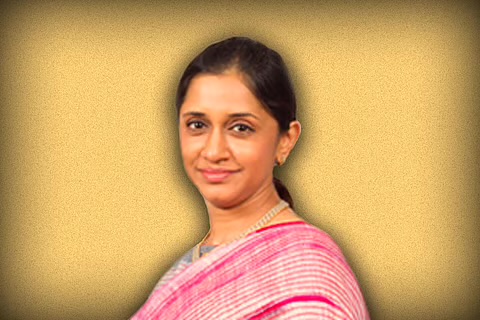
Malavika Hegde, a businesswoman and entrepreneur from India, is known for her great role in the revival of Café Coffee Day (CCD), which is the country’s largest coffee retail chain. After taking over the company, which was founded by her husband, the tragic 2019 death of V.G. Siddhartha, the founder of Café Coffee Day, she got national recognition. At that time, the company was burdened with large debts, financial instability and was also hit by the early stages of the COVID-19 pandemic, which made things worse. But Malavika did very well in that tough situation; she stabilised the company and brought it out of the crisis. Her willpower, cool-headed decisions and business strategy have made her one of India’s most respected corporate leaders.
Born in ’69 in Bengaluru, Karnataka, Malavika Hegde is from a political family. She is the daughter of the late S.M. Krishna, who served as the Chief Minister of Karnataka and also as India’s External Affairs Minister. In a setting that put stress on public service, discipline and leadership, which in turn shaped her from a young age. Although born into a great family that had politics in it, Malavika kept away from the public eye; instead, she put her energy into her studies and professional growth, which took precedence over political life.
Malavika did her schooling in Bengaluru, which was followed by a B.Tech degree from Bangalore University. She studied engineering, which in turn gave her analytical and problem-solving skills, which she put to use in perhaps the most trying times for Café Coffee Day. Although today she is known as a business leader, many may not realise how her technical background played a key role in her understanding of operational issues and in making informed financial decisions.
In 1991, Malavika tied the knot with V.G. Siddhartha, which was the visionary’s foray into the Indian market’s unorganised café scene that he in turn transformed into the very structured Café Coffee Day. Out of which came a brand which today is one of the best-known coffee brands in India. Also, a man who spent a great amount of time in his ventures, he built out spaces for people to come together, to work and to socialise over a cup of coffee. For the large part, through the early years of the company’s growth, Malavika was in the background, which saw through the implementation of various business ideas and at the same time running a private home front. They had two sons, Amartya Hegde and Ishaan Hegde, and yet out of all the challenges that came out of a very public entrepreneurial life, they created a very close family.
Before joining the Café Coffee Day team, Malavika was a part of the growth story of The Serai Resorts, the luxury hospitality unit within the Coffee Day Group. In that role, which mostly stayed private, she was involved in the management and development of the premium resort chain, which gave her a deep well of experience in hospitality, customer service and business operations. Although she didn’t put herself forward in public forums, over the years, she built up a very strong knowledge of the group’s businesses.
In 2019, everything changed when V.G. Siddhartha died suddenly. His passing shocked the business community and left Café Coffee Day with serious financial issues. At the time, the Coffee Day Group was reported to be over Rs 7000 crore in debt, which in turn made the company’s future very uncertain. Investors, lenders, employees and customers were unsure if the icon of the coffee chain had run its course.
Reduce debt, restore stakeholder confidence, and preserve the legacy that her husband built up over many years.
During her tenure, which saw a string of strategic initiatives introduced to improve Café Coffee Day’s financial health, the company got into the practice of offloading non-essential assets, trimming operations, cutting out unneeded expenses, and, at the same time, put more focus on those business segments that proved to be the most profitable. Also, we see that poorly performing outlets were shut down, and those that did well in the café and vending machine sectors were given more attention. Also, what the company did was to speed up debt repayment through asset monetisation and, at the same time, report better performance from operations.
Malavika’s leadership, which up to that point had been very successful, was put to the test with the arrival of the COVID-19 pandemic, which hit the hospitality and food service sectors hard worldwide. Though we saw a reduction in customer traffic and extended lockdowns, Café Coffee Day did very well via some smart financial moves and restructuring of operations. The company’s comeback has been brought up by industry experts as a prime case of Indian corporate turnaround.
By 2025, Café Coffee Day had put in place a great turnaround in its financial health. The company, which ran over 420 cafés in the Indian market, also ran what was at that point the largest coffee and tea machine network in the country, which they had in offices and commercial buildings. Also, what was very much a point of note was the report of improved revenues and the return to profit after a few years of loss, which we saw as a great success of Malavika’s long-term restructuring efforts.
In 2025, the company’s board recognised Malavika Hegde’s contribution, which led to her appointment as Chairperson of Coffee Day Enterprises Limited (CDEL). Also, she was reappointed as Whole-time Director and Chief Executive Officer for a term which is to be extended; this is the board’s vote of confidence in her leadership and strategic vision. Her appointment was a milestone in the company’s transition from crisis management to sustainable growth.
Apart from what was financial in nature, Malavika also dealt with legal issues related to the investigation of past foreign investment deals. In Jan 2026, the Karnataka High Court issued an interim relief, which is a stay of proceedings brought forward under the Foreign Exchange Management Act. The court pointed out procedural issues that gave the company a break to focus on its business while the lawsuit played out. That gave the company additional stability during its which were to do with recovery.
Although it has not been officially revealed what Malavika Hegde’s net worth is, reports from financial analysts put her at several hundred crores, which she has acquired through her stake in Coffee Day Enterprises and related businesses. But what is more valuable about her is that she has preserved India’s most iconic consumer brand and protected the lives of thousands of employees of the Coffee Day Group.
Beyond business success, Malavika is known for her humility and private life. Unlike many of the corporate elite, who seek out media attention and public recognition, she does not. Instead, she lets her work do the talking. What also earns her admiration in India’s business community is her ability to lead a corporate turnaround while also managing family responsibilities. Malavika Hegde’s story is a story of how resilience, courage, and responsible leadership play out. She took over an org that was at a financial rock bottom, but didn’t allow a few decades of hard work to go down the drain. Through patience, with strategic planning and unyielding determination, she turned around Café Coffee Day from a struggling, debt-laden company into a business that saw stability and restored investor faith.
Today, Malavika Hegde is a name associated with that of the leader who brought back Café Coffee Day, but also one of India’s most inspiring women entrepreneurs. Her tale proves that great leadership comes out of crisis and that it is perseverance, good judgment, and quiet willpower that, in fact, overcome what seem like insurmountable challenges. As Café Coffee Day continues on its path of growth and innovation, Malavika Hegde’s role will be a large part of India’s corporate history.
About the Author