Know About India’s Thar Desert: Map, Facts & Information (2026)
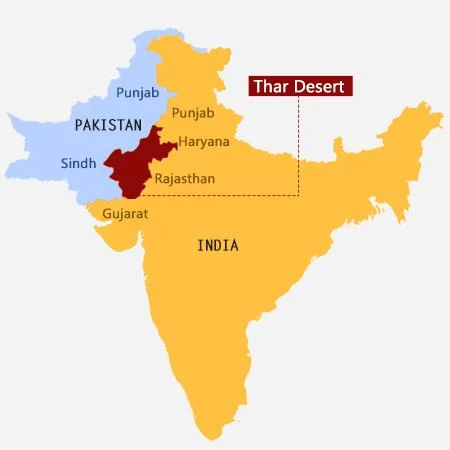
Stretch a map of northwestern India across your screen and you’ll spot a golden expanse rolling across Rajasthan and spilling gently into Punjab, Haryana, Gujarat, and across the border into Pakistan. That’s the Thar Desert — India’s largest desert, often called the Great Indian Desert — sprawling across more than 77,000 square miles. It’s a place where sand dunes rise like frozen waves, where camels still outnumber cars on certain stretches, and where an ancient river disappears into its own shadow every year.
Where Exactly Is the Thar Desert?
The bulk of the Thar sits in Rajasthan, though smaller slivers reach into neighboring Indian states. Roughly 15 percent of the desert actually belongs to Pakistan, tapering off where the Indus River’s floodplains bring enough moisture to soften the landscape. On a map, it looks less like a single unbroken desert and more like a slow fade from sand to greenery as you approach the river.
A Landscape Shaped by Time
Geologists still argue about the Thar’s exact age, but most estimates place it somewhere between 4,000 and 10,000 years old — young, by geological standards. Its dunes tell their own story: modest ridges around 52 feet tall in the north grow into towering formations exceeding 490 feet in the south. Roughly five millennia ago, this land wasn’t empty at all — it bordered one of history’s great civilizations, with Mohenjo-daro rising near the Indus not far to the north.
Jodhpur: A City Built on Defiance of the Desert
Founded in 1459, Jodhpur remains proof that even the harshest terrain can host a thriving city. Home to around 1.5 million people today, it draws travelers from across the globe thanks to landmarks like the imposing Mehrangarh Fort, which watches over the city from its rocky perch. Curiously, the Thar has no oases at all — a rarity among the world’s major deserts. Its only real water source is the Luni River, which begins in the Naga hills, stays fresh for roughly its first 100 kilometers, then turns increasingly saline as it widens and shallows before vanishing into Gujarat’s marshes each dry season.
Surprising Numbers Worth Knowing
The Thar defies almost every desert stereotype. While the Sahara supports barely one person per square kilometer, the Thar houses about 83 — making it the most densely populated desert on Earth. Families here often live under one roof across generations, pooling their earnings as a shared household resource. Despite scorching summers between 75-79°F and winters dropping to near-freezing lows of 39-50°F, the region supports more than 40 mammal species and produces more wool than anywhere else in India.
History was also made here in a very different sense: on 18 May 1974, India conducted its first nuclear test within these very sands.
Getting There
There’s no international airport inside the desert itself, but Jaipur International Airport sits just beyond its edge, while Delhi’s Indira Gandhi International Airport offers broader global connections. From either, domestic flights or India’s extensive rail network — including direct trains to Jodhpur — make reaching the Thar refreshingly simple, for a desert that seems, at first glance, so remote.
About the Author