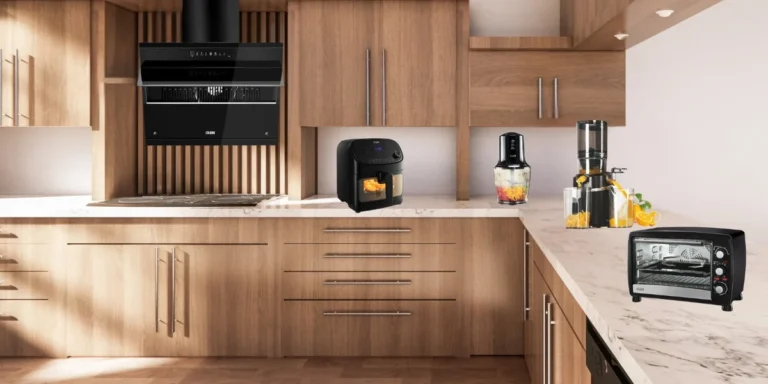
Limited counter space became a real problem when everyday cooking started feeling cramped. With the cooktop, chopping area and frequently used items already competing for room, adding another appliance often meant sacrificing the little preparation space I had left. I realised that choosing an appliance only for its features was no longer practical.
That’s why I had to change my approach. I began prioritising compact size, easy storage and multiple uses over impressive specifications. If an appliance could not earn its space through regular use, I simply stopped considering it.
Limited Space Made Me Rethink What an Essential Appliance Really Is
When counter space is generous, it is easy to buy an appliance for one specific purpose. In a smaller kitchen, that approach quickly creates clutter. I now start by looking at my actual cooking routine.
Which tasks do I repeat every day? Which ones take the most time? Which appliances stay unused for weeks? And could one appliance perform two or three of the jobs for which I currently use separate equipment?
This matters because modern kitchens are being asked to do more within increasingly efficient layouts. Cooking, preparation, storage and sometimes even dining have to coexist within the same limited area.
That means the most useful electric kitchen appliances are not necessarily the biggest or the ones with the longest feature lists. They are the ones that deliver meaningful functionality without demanding unnecessary space.
Versatility Has Become My First Measure of Value
I have found that multifunctionality becomes particularly important when space is limited.
A good example is a hand blender. Instead of requiring a permanent position on the counter, it can be stored away relatively easily and brought out only when required. More importantly, it can handle several everyday preparation tasks.
The Wipro Hand Blender 300 Watt, for instance, is designed for blending, whisking and pureeing. Its food-grade stainless-steel stem allows ingredients to be processed directly in pots or containers, while its lightweight construction makes it easier to store than many conventional countertop appliances.
That direct-in-the-pot approach is something I particularly value in a small kitchen. It can reduce transfers between vessels, limit the number of containers used and consequently cut down on both clutter and cleaning.
For me, that is a useful way to assess innovation: not simply by asking how many functions have been added, but by looking at how much everyday friction they remove.
I Look at Storage Footprint, Not Just Countertop Footprint
One mistake I used to make was checking whether an appliance would fit on my counter without thinking about where it would go afterwards.
Now I consider the complete storage journey before buying anything.
An appliance may have a compact base but come with several jars, attachments or accessories that require considerable cabinet space. In contrast, a thoughtfully designed small appliance can move easily between the counter and storage.
This is where products such as the Wipro Vesta Mini Handy and Compact Electric Chopper make sense within a limited-space kitchen. It is designed to handle everyday chopping of ingredients such as vegetables, herbs and nuts while maintaining a relatively compact format.
The larger lesson for me is that kitchen efficiency depends on reducing the amount of equipment required around a task. If one compact appliance can shorten preparation time without creating another storage problem, it adds greater practical value.
Multi-Use Appliances Help Me Avoid a Counter Full of Single-Purpose Tools
I also increasingly favour appliances that can support several types of meals.
A sandwich maker, for example, becomes much more useful to me when its cooking surface can accommodate more than sandwiches. The Wipro Elato Super Jumbo Ceramic Grill Sandwich Maker can also be used for foods such as grilled vegetables and tikkas, allowing one compact appliance to support different quick-meal occasions.
This is an important consideration in compact kitchens.
Every single-purpose appliance potentially occupies space that another more versatile appliance could use more effectively. When I evaluate kitchen appliances now, I therefore think in terms of meals rather than features. If an appliance can help me prepare breakfast, snacks and portions of dinner, it becomes much easier to justify the space it occupies.
Good Kitchen Planning Starts with Habits, Not Appliance Lists
The biggest lesson I have learned is that there is no universal list of appliances for a small kitchen.
Someone who prepares smoothies every morning has different requirements from someone who regularly grills snacks or cooks elaborate Indian meals. Space-saving therefore begins with understanding behaviour.
Before choosing anything, I now consider four things:
- Frequency of use: Will I realistically use it several times a week?
- Multiple functions: Can it replace another appliance or manual tool?
- Ease of storage: Can I put it away conveniently after use?
- Ease of cleaning: Will using it create more work than it saves?
These questions help me distinguish genuinely useful innovation from features that may look impressive but contribute little to my routine.
The Future of Compact Kitchens Is About Doing More with Less
Living with limited counter space has made me appreciate a different kind of kitchen innovation.
I no longer see a well-equipped kitchen as one filled with appliances. I see it as a space where every appliance has a clear purpose and where design, versatility and convenience work together.
About the Author