Integrated Dual Degree or Traditional Degree? Making the Call in 2026
Every year, students reach the same fork. Do you join one long program that ends with a bachelor’s and a master’s, or take the bachelor’s first and figure out the rest later? Jobs are harder to land in 2026 than they were a few years ago, so this is worth thinking through before you commit.
How an integrated program works
You apply once and follow a single track. When it’s over, you hold both qualifications. Engineering is the usual example: B.Tech and M.Tech together take five years, while doing them separately takes about six. BBA with MBA and BS with MS follow the same idea, and institutes like the IITs offer several of these.
The traditional route
Here you finish the bachelor’s and then decide what’s next. That gap matters more than it looks. Some people use it to work, some switch universities, and some go abroad. A commerce graduate who spends two years in an office often arrives at an MBA with far better examples to share. A science student who suddenly falls for data analysis can change direction without much trouble.
Where they really differ
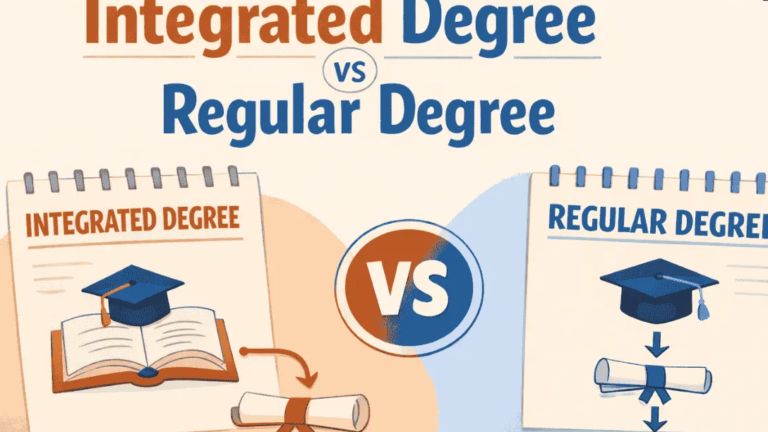
Time is the obvious one. Integrated programs save around a year, while the separate path can stretch to six years or longer. Cost usually follows, since one enrollment tends to be cheaper than two, and living expenses add up over the extra time. Flexibility goes the other way. Walking out of an integrated course halfway is messy, whereas the traditional route lets you change your mind. On depth, integrated programs dig deeper into one subject, which helps if you’re aiming at research or a PhD.
What can go wrong
The integrated path asks for certainty. If you lose interest in year three, you either push on unhappily or start over. It also isn’t always worth it: in management and law, a few years of work experience can count for more than another degree.
The traditional path has its own trap, and it’s called life. Plenty of graduates fully plan to come back for a master’s, then a job offer, a loan, or family needs get in the way. Some never return.
So which one?
If you already know your field, want to save time and money, and like research or academia, the integrated program suits you well. If you’re still curious, want to earn before studying further, or might move universities or countries, take the longer route and keep your options open.
About the Author