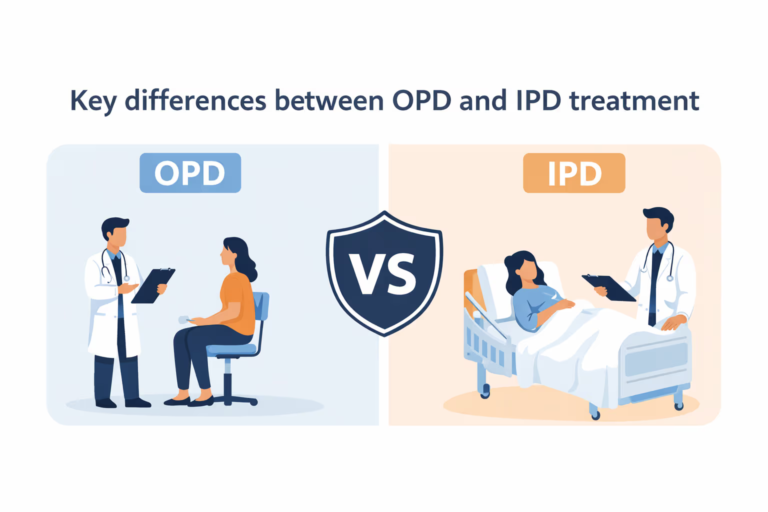
Know the Difference Between OPD and IPD in 2026
Anyone who’s ever filled out a health insurance claim form has probably stared at these two abbreviations and felt a small flicker of confusion. OPD. IPD. They sound almost interchangeable, but they mean very different things when it comes to your treatment, your bill, and eventually, your insurance payout.

Let’s break it down properly.
OPD: The Quick In-and-Out Visits
OPD stands for Outpatient Department. Basically, it’s every visit to a doctor or clinic where you don’t end up staying the night. A check-up for a fever, an eye test, a dental filling, physiotherapy sessions, blood work — all of that falls under OPD. You walk in, get treated, and walk right back out.
Because there’s no hospital bed or nursing staff involved, OPD is naturally cheaper and quicker. But here’s the catch a lot of people miss: not every health policy covers OPD expenses fully, or at all. Some plans treat it as an add-on you have to specifically opt for, while others include it only up to a certain limit. So before assuming your clinic visits are covered, it genuinely pays to check the policy wording.
IPD: When You Actually Get Admitted
IPD, or Inpatient Department, is what happens when your condition needs you to stay in the hospital — usually for 24 hours or longer. Surgeries, childbirth, serious infections requiring monitoring, accidents — these are classic IPD situations.
The billing works differently too. Instead of paying for each service separately, everything gets bundled into one hospital bill: room rent, doctor’s fees, medicines, tests, nursing charges, the works. And unlike OPD, most standard health insurance policies are built specifically around covering this kind of hospitalization, so claims here tend to go through more smoothly.
So What’s the Real Difference?
At its core, it comes down to whether you’re admitted or not. But that one distinction ripples into a lot of other things — how you’re billed, how long your treatment takes, whether pre-authorization is needed, and how easily your insurance claim gets processed.
OPD tends to be flexible and low-commitment. You can book an appointment, get it done, and move on with your day. IPD, on the other hand, involves more paperwork, more planning, and often a higher overall cost — but it also comes with continuous medical supervision, which matters a lot when a condition is serious.
Why This Matters Right Now
Healthcare in 2026 looks a bit different than it did even five years ago. A lot of procedures that once required hospital admission are now done as day-care treatments — cataract surgery, certain endoscopies, even some minor orthopedic work. That shift means more people are relying on OPD-type care than before, yet insurance products haven’t always kept pace.
If you find yourself visiting clinics more often than hospitals, it might be worth checking whether your policy has a dedicated OPD benefit, rather than assuming your existing cover handles it. On the other hand, don’t skimp on IPD coverage either — a sudden hospitalization can still be financially brutal without it.
Bottom Line
OPD and IPD aren’t really rivals; they cover two different stages of the same healthcare journey. One takes care of routine, everyday medical needs. The other steps in when things get serious enough to need a hospital stay. Knowing which is which — and what your policy actually covers — can save you a lot of stress (and money) when you least expect to need it.
As always, terms, waiting periods, and exclusions differ from insurer to insurer, so it’s worth a quick read of your policy document, or a call to your provider, before you actually need to use it.
About the Author