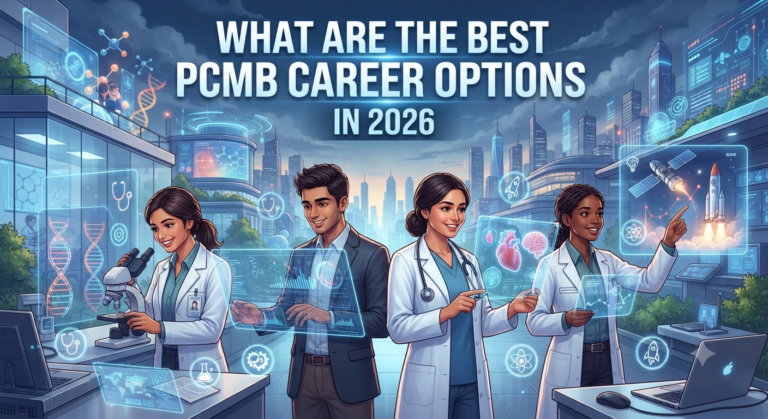
It can seem a bit overwhelming to opt for Physics, Chemistry, Mathematics and Biology (PCMB) in Classes 11 and 12. The great thing is that PCMB students can pursue a variety of careers in medicine, engineering, biotechnology, data science, pharmacy, agriculture, food technology and scientific research, rather than needing to choose between the maths- and biology-based streams.
This is especially valuable in 2026, as new, modern professions are emerging at the intersection of biology, technology and data. The National Education Policy of India also includes the idea of multidisciplinary learning and flexibility in education.
Why Is PCMB a Flexible Stream?
A student who likes to do numbers in the morning and biology at the end of the day doesn’t need to sacrifice one of them. PCMB has subject combinations available in most of the Higher Education paths.
For instance, NEET-UG is used for admission to Under-graduate Medical education and also some AYUSH courses. NEET is also used to get admission to B.Sc. Nursing courses, such as those provided by NTA for the Armed Forces Medical Services.
Concurrently, there are engineering and technology programmes for which the eligibility is based on the mathematics component, where PCM could be beneficial.
It’s important to note that although PCMB offers more opportunities, it is not a guaranteed place. Requirements for admission and eligibility vary from university to course.
1. Medicine and Healthcare
If you are most interested in patient care and clinical medicine, PCMB offers you several health-care options.
Possible choices include:
- MBBS
- BDS
- BAMS
- BHMS
- BUMS
- BSMS
- B.Sc. Nursing
- Access to physiotherapy and other allied health programmes (if eligible institution)
The NEET-UG 2026 is the all-India common entrance test for admission to undergraduate medical courses in India and also for various Indian Systems of Medicine and homoeopathy courses.
Medicine is a long-term course, and students should not be swayed by the popularity of a course; they should think about whether they enjoy biology, patient contact and clinical learning, and whether they enjoy the years of study they would need to do.
2. Engineering and Technology
PCMB also has a strong component of maths which can be extended into engineering.
Eligibility requirements and location will dictate the options, which may include:
- Computer Science and Engineering
- Biotechnology Engineering
- Biomedical Engineering
- Chemical Engineering
- Electrical and Electronics Engineering
- Mechanical Engineering
- Civil Engineering
- Environmental Engineering
- Aerospace and related engineering fields
Biomedical engineering and/or biotechnology may be interesting for a student who likes both biology and technology because it is a field that bridges the two.
3. Biotechnology, Microbiology and Life Sciences
Not all PCMB students aspire to be doctors or engineers – that is perfectly okay.
Biotechnology, Microbiology, Biochemistry, Genetics, Molecular Biology and Life Science Degree programmes open up opportunities in the laboratory, pharmaceutical firms, diagnostics, food industries, research organisations and higher education.
This is where PCMB can have a very special meaning: Mathematics and statistics can aid in the study of biological phenomena, and chemistry and biology can offer a scientific underpinning.
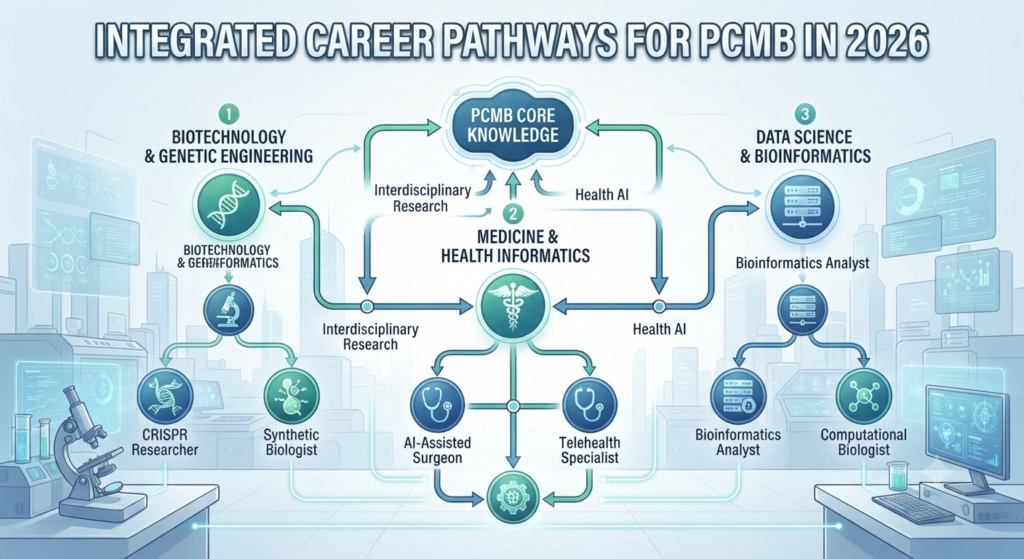
4. Data Science, Artificial Intelligence and Bioinformatics
One of the new areas that may be explored in 2026 is the fusion of biology and computational science.
If you are interested in mathematics and programming, you should consider the following specialities:
- Data Science
- Artificial Intelligence
- Bioinformatics
- Computational Biology
- Health Informatics
- Biomedical Data Analysis
These fields are increasingly relevant to areas such as genomics, drug discovery, medical research and healthcare analytics.
Note that students should be aware that it is not a mandatory subject for someone who wants to be a data scientist, and taking PCMB is not sufficient. Programming, statistical, database and computational skills must be acquired through a relevant degree, elective programs, certification or through a project.
5. Pharmacy and Pharmaceutical Sciences
Students who are interested in medicines and formulation of drugs and the pharmaceutical industry can have a look at B.Programmes related to Pharm.
Careers in a pharmacy can be more than just working in a retail pharmacy. Experts may advance to fields like pharmaceutical manufacturing, quality control, quality assurance, regulatory affairs, and clinical research and drug development, depending on qualifications and experience.
It can be a fascinating alternative to a conventional medical career for medical science enthusiasts interested in the science involved in the formulation and testing of medicines.
6. Food Technology and Agriculture
PCMB can be a driver beyond hospitals and labs.
Students are able to study Food Technology, Dairy Technology, Agricultural Science, Horticulture and Environmental Science-related programmes. For instance, the CBSE Career Handbook has options for students with a relevant PCM/PCMB background, such as B.Tech. in Food Technology, Dairy Technology and Biotechnology, etc.
These specialisations can branch out into food processing, quality assurance, product development, agricultural research, sustainability and other related areas.
7. Forensic and Environmental Science
If the solution of scientific problems appears more exciting than working within a hospital, then consider one of the following: Forensic Science and Environmental Science.
Forensic science is the science of examining evidence using biology, chemistry and analytical techniques, and environmental science is the science of studying environments using biology, chemistry and physical sciences, including pollution, climate and sustainability.
These are good examples of why PCMB should not be viewed simply as a “medical or engineering” stream.
How Should a PCMB Student Choose a Career?
The most common error is selecting a course for the purpose that it is termed a “high-salary career.”
Instead, ask yourself:
- Do I enjoy working with patients? → Explore healthcare and medicine.
- Do I enjoy mathematics, coding and technology? → Consider engineering, data science or AI.
- Do I enjoy laboratory experiments and biological research? → Explore biotechnology, microbiology or life sciences.
- Do I like medicines and chemical formulations? → Consider pharmacy and pharmaceutical sciences.
- Do I enjoy food, manufacturing and quality testing? → Explore food technology.
- Do I enjoy nature, sustainability and scientific investigation? → Consider environmental or agricultural sciences.
Final Thoughts
While PCMB is a demanding test, it’s the variety of directions it won’t refuse to open that makes it the real challenge. It’s not necessary to choose a career right after Class 12.
It is important to consider the eligibility criteria, entrance tests, course duration, course curriculum and future career prospects before choosing a course.
The number of courses available is interesting, but in my personal view, what’s most interesting about PCMB is the variety of courses available. It is the idea of bringing together disciplines. Any student might start in biology, then move to working with artificial intelligence, or biotechnology and data science, or food science and industrial biotechnology.
In 2026, careers are becoming more and more subject-specific. For a PCMB student, this can be the basis for investigating a range of different science and technology futures.
About the Author