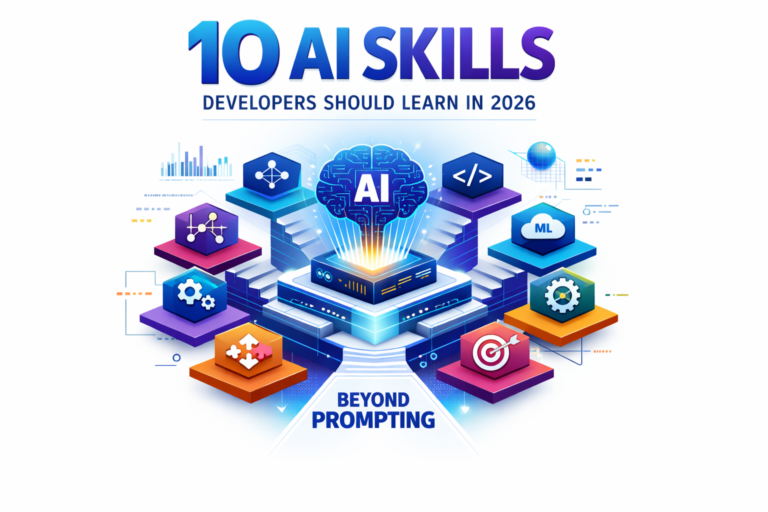
The AI Skills Employers Actually Want in 2026
Here’s the truth nobody tells you: knowing what ChatGPT is doesn’t make you employable anymore. The AI hiring market has quietly shifted from “who understands this stuff” to “who can actually ship it.” If you’re eyeing a career in AI this year, here are the ten skills separating candidates who get hired from those who get ghosted.
1. Prompt Engineering (But the Real Kind)
Not “type a clever question into ChatGPT” prompt engineering — the kind where you’re building multi-step prompt chains, reusable templates, and systems that stay reliable at scale. Companies deploying tools like Claude or GPT-based copilots need people who can make these systems behave predictably, not just impressively in a demo.
2. Applied Machine Learning
The gap between “I trained a model in a notebook” and “I deployed a model that makes the company money” is enormous. Employers want engineers who can turn messy, real data into working systems — think fraud detection, churn prediction, recommendation engines — using tools like XGBoost and scikit-learn.
3. Deep Learning (PyTorch and TensorFlow)
This is still the engine behind the flashiest AI applications: medical imaging, self-driving perception, advanced language models. If you understand transformers, CNNs, and how to squeeze performance out of limited hardware, you’re solving problems most people can only theorize about.
4. Fine-Tuning and RAG
Generic AI answers don’t cut it in the enterprise world. Businesses want models that know their data — their contracts, their support tickets, their internal policies. That means knowing how to build retrieval pipelines with tools like LangChain and vector databases such as Pinecone, and fine-tune models with techniques like LoRA.
5. MLOps
A brilliant model sitting in a Jupyter notebook is worthless. MLOps is the discipline of getting models into production and keeping them there — through Docker, Kubernetes, CI/CD pipelines, and constant monitoring for drift.
6. Data Engineering for AI
Every model is only as good as what feeds it. Building resilient pipelines with tools like Apache Kafka, Airflow, or Snowflake has become just as critical as the modeling itself.
7. NLP with Transformers
From chatbots to contract analysis, transformer models (BERT, LLaMA, and friends) are how machines read and reason about language. This skill sits at the heart of nearly every text-based AI product being built right now.
8. Computer Vision
Factories, hospitals, and self-driving cars all lean on vision systems to catch what human eyes miss. Skills in tools like YOLOv8 and OpenCV are opening doors in manufacturing, healthcare, and automotive tech.
9. AI Plus Domain Expertise
The most valuable AI professionals aren’t generalists — they’re people who understand both the tech and the industry it serves, whether that’s banking regulations, hospital workflows, or supply chain logistics.
10. Generative AI and Diffusion Models
Text-to-image, text-to-video, and multimodal generation have moved from novelty to necessity in marketing, design, and product development, powered by tools like Stable Diffusion and ControlNet.
The bottom line: theory alone won’t get you hired anymore. 2026 belongs to people who can build, deploy, and explain AI systems that solve real problems.
About the Author