Skanda is an important deity in Hinduism who is traditionally associated with war, courage, leadership and victory. He is also widely known by names such as Kartikeya, Murugan, Subrahmanya, Kumara and Shanmukha. While the traditions surrounding him vary across different regions of India, Skanda is particularly prominent in Tamil Hinduism and is worshipped as Murugan.
Also Read: Top 10 Hardest Exams In 2026
Skanda is commonly described as the son of Shiva and Parvati and the brother of Ganesha. His mythology connects divine power with the protection of righteousness and the defeat of forces representing disorder.
Who Is Skanda in Hinduism?
Skanda is traditionally regarded as a youthful warrior deity and commander of the divine army. His name appears prominently in ancient Sanskrit literature, including the Mahabharata, Ramayana and Puranic traditions.
The name Skanda has several traditional interpretations and associations. He is frequently portrayed as a powerful, energetic and courageous deity who leads the gods in battle.
His different names reflect different aspects of his identity:
- Kartikeya – associated with the Krittika stars or mothers
- Murugan – a particularly important name in Tamil tradition
- Subrahmanya – a prominent name in South Indian worship
- Shanmukha or Shadanana – meaning six-faced
- Kumara – meaning youth or prince
- Guha – associated with the idea of being hidden or mysterious
Skanda as the God of War
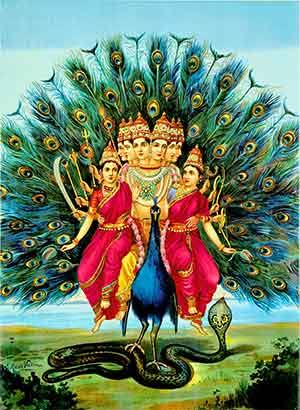
Skanda’s best-known role is that of a warrior and commander. Hindu mythology describes him as leading divine forces against powerful enemies of the gods.
His warrior identity does not simply represent physical warfare. In many religious interpretations, his battles can also symbolize the struggle between dharma and adharma, courage and fear, and spiritual knowledge and ignorance.
His qualities include:
- Courage
- Leadership
- Strength
- Discipline
- Determination
- Protection of righteousness
- Victory over negative forces
The Birth of Skanda
Different Hindu texts and traditions provide different versions of Skanda’s birth.
A widely known Puranic account connects his birth with a divine need for a powerful warrior capable of defeating the demon Tarakasura. According to the mythology, Skanda emerged through extraordinary divine circumstances involving Shiva and the divine power associated with Parvati.
Another important element of his mythology involves the Krittikas, traditionally identified with the Pleiades. This is connected with his name Kartikeya and with stories explaining his multiple faces.
Because Hindu mythology developed through numerous texts and regional traditions, details of Skanda’s birth can differ between sources.
Why Does Skanda Have Six Faces?
Skanda is frequently represented with six faces, which gives him the names Shanmukha and Shadanana.
Different traditions offer different symbolic interpretations of the six faces. They may represent multiple forms of divine awareness, powers or directions. Some traditions also connect them with the six Krittika mothers who cared for the infant deity.
The six-faced form emphasizes Skanda’s extraordinary divine nature and his ability to perceive and act in multiple directions.
Skanda and His Spear
One of the most recognizable symbols of Skanda is the Vel, a sacred spear particularly prominent in Tamil traditions of Murugan worship.
The Vel is associated with:
- Divine power
- Courage
- Protection
- Destruction of evil
- Spiritual knowledge
In symbolic interpretations, the spear can represent the focused power of wisdom overcoming ignorance.
Skanda’s Peacock and Other Symbols
Skanda is commonly depicted riding a peacock, which is one of his principal symbols. The peacock is known as Paravani in some traditions.
His imagery may also include the rooster emblem, known as Seval, particularly in Tamil traditions.
Together, these symbols reinforce themes of strength, victory, divine protection and the overcoming of negative forces.
Skanda and His Family
Skanda is generally described as the son of Shiva and Parvati. He is also traditionally regarded as the brother of Ganesha.
His family relationships are an important part of Hindu mythology and temple traditions. In South Indian traditions, especially those centered on Murugan, he is also associated with Valli and Devasena, who are regarded as his consorts in different traditions.
Worship of Skanda in India
Skanda is worshipped throughout India, but his importance is particularly strong in Tamil Nadu, where he is known as Murugan.
Important temples dedicated to Murugan and Skanda include the traditional Arupadai Veedu, the six principal sacred abodes of Murugan in Tamil Nadu.
Major festivals associated with him include Thaipusam and Skanda Sashti, although their observance and customs vary by region and community.
Spiritual Significance of Skanda
Beyond his identity as a warrior deity, Skanda represents qualities that devotees may seek to cultivate in their own lives. His courage can symbolize the ability to confront difficulties, while his victory over demonic forces can represent overcoming ignorance, fear and destructive tendencies.
His youthful appearance is also associated with vitality, energy and spiritual strength.
Also Read: How to get an Insurance Agent License in India In 2026
Conclusion
Skanda is one of the major warrior deities of Hinduism and is worshipped under many names, especially Kartikeya and Murugan. His mythology emphasizes courage, leadership, divine protection and the triumph of dharma. Through his association with the Vel, peacock, six faces and divine army, Skanda remains an important figure in Hindu religious traditions in 2026.
About the Author