
There are two basic types of digital circuits that are used in electronic and computing systems: combinational circuits and sequential circuits. The difference is that while combinational circuits rely on their current inputs, sequential circuits rely on information stored in the past in addition to their current inputs.
What are Combinational Circuits?
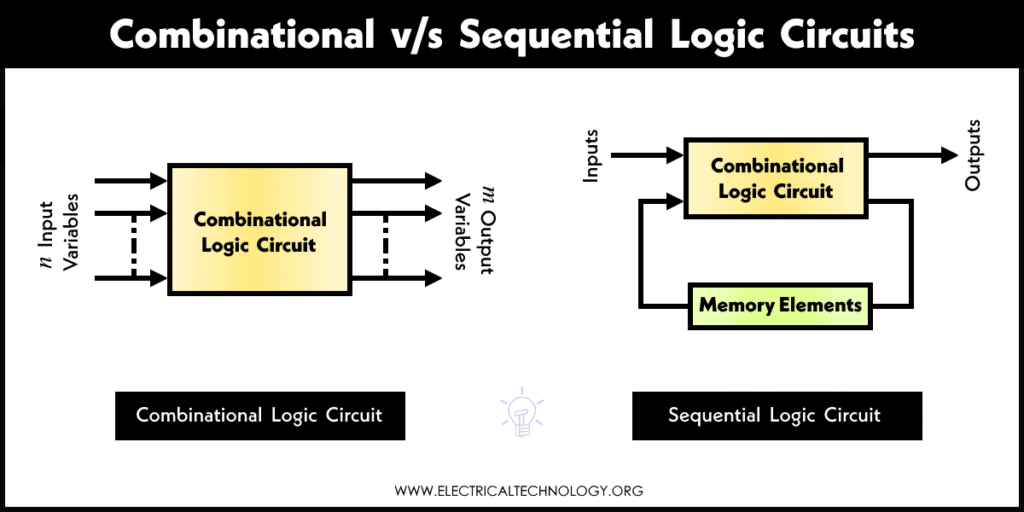
A combinational circuit is a circuit that has outputs that depend only on current inputs. It lacks memory and feedback. They are commonly used in adders, subtractors, multiplexers, encoders, and decoders.
Sequential Circuits
A sequential circuit has outputs that depend on its previous state as well as current inputs. Uses memory elements like flip-flops and may operate in conjunction with a clock signal. Common examples are counters, registers, and shift registers.
Key Difference
The difference between a combinational circuit and a sequential circuit is that a combinational circuit has no memory, while a sequential circuit has memory. Usually, combinational circuits don’t need a clock, while sequential circuits make use of clock signals to control the state changes.
What is a Combinational Circuit?
In a combinational circuit, the logic gates are the elements that process the current binary input(s) and produce the desired output. The output changes when the input changes, depending on the logic function of the circuit, with a small propagation delay.
What is the working of a Sequential Circuit?
Sequential circuits store the previous state of the circuit using memory elements. These circuits are used in sequences of operations because they can take information that has been stored and then add it to the input to decide on the next state and output.
Examples of Combinational Circuits Applications
Arithmetic computations, data selection, coding, decoding, and digital signal processing are common examples of combinational circuits. They play a crucial role in the functioning of computers and electronic digital devices.
Sequential Circuits Applications
Counters, registers, memory systems, and control units make use of sequential circuits. They are particularly useful when a digital system needs to remember information or perform operations in a particular sequence.
Conclusion
The difference between combinational and sequential circuits is primarily related to the use of memory and past states. Circuits that use combinational logic rely solely on inputs at the moment, while sequential circuits rely on inputs at the moment, as well as the information stored in the circuit. Both serve as key elements of today’s digital electronics.
About the Author