The words “calories” and “kilocalories” are used in nearly every diet and weight management or healthy eating conversation. However, do they really differ? Yes and No, depending on the use of the terms.
This minor distinction in word usage can cause a lot of confusion when reading the label, keeping track of meals or following a diet plan. Let’s keep it simple.
What Is a Calorie?
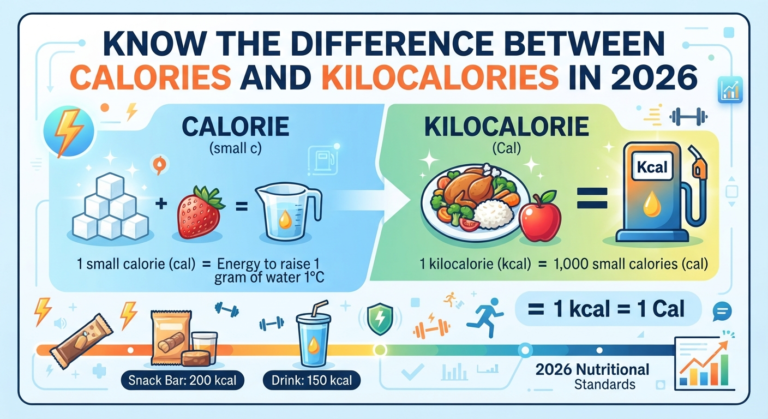
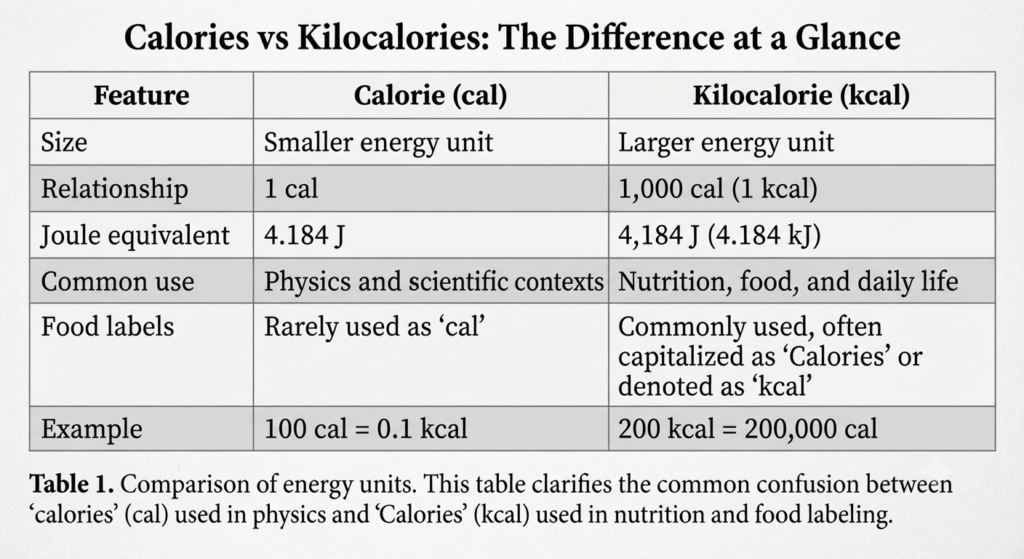
A calorie (cal) is a scientific unit of energy. One small calorie is the amount of energy required to raise the temperature of 1 gram of water by approximately 1°C.
In scientific terms:
1 calorie = 4.184 joules
Such small calories are, however, seldom used when talking about the calories consumed by the average person in their daily diet, as the numbers would be unnecessarily large.
What Is a Kilocalorie?
A kilocalorie (kcal) is simply 1,000 small calories.
Therefore:
1 kilocalorie = 1,000 calories
1 kcal = 4,184 joules
Kilocalories are the units commonly used in nutrition to describe the energy supplied by food and beverages.
Then Why Do Food Labels Say “Calories”?
This is where the majority of the confusion starts.
When a food packet says “200 Calories,” it generally means 200 kilocalories (200 kcal), not 200 of the tiny scientific calories.
In common parlance, the word “calorie” is often used to refer to the Kilocalorie. The FDA, for example, uses “Calories” on Nutrition Facts labels to describe the energy obtained from food.
So, if your breakfast cereal says it contains 200 Calories in a serving, you can see that that’s about 200,000 small calories.
Why Does This Matter for Your Diet?
It’s helpful to know the terms, but don’t get nervous about all the numbers on a food label. The actual significance is how much energy you are using versus how much energy your body needs.
Food provides energy mainly through carbohydrates, proteins, fats and alcohol. That energy is used by your body for vital activities like breathing, circulation, body temperature, movement and physical activity.
For instance, if you eat a snack that has 150 Calories per portion, but you consume 2 portions, you are getting about 300 Calories. That’s why it’s as crucial as reading the calorie count to read the serving size and number of servings per package.
A Common Mistake to Avoid in 2026
Many of the most common errors are the assumption that calorie and kcal are synonymous or that calories are measured in the same units. This is not the case scientifically. A kilocalorie is 1000 times bigger.
Meanwhile, nutrition professionals and nutrition labels typically use “Calories” to mean “kilocalories.” Thus, the context is important.
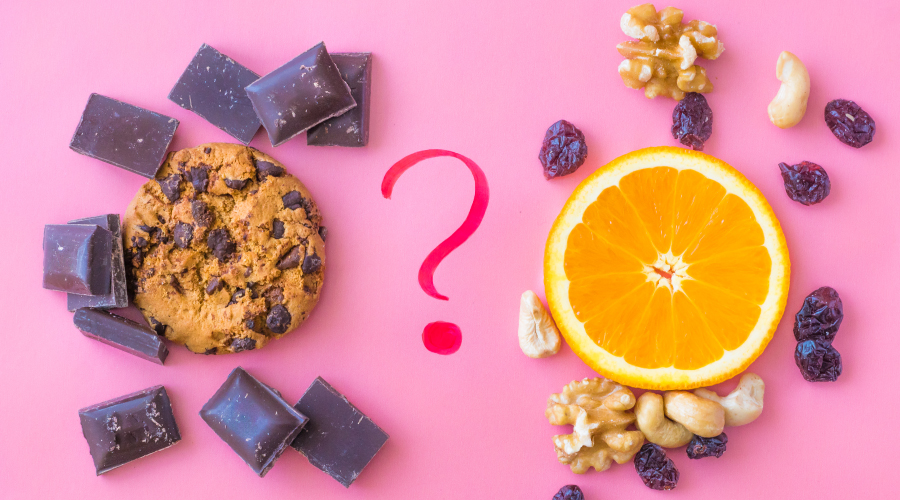
An additional note: calories provide information on energy, not the nutritional quality of a food. There are two food items that can have the same number of calories, but vary significantly in their protein, fibre, vitamins, minerals, fat and other nutrient content.
The Bottom Line
It’s really quite simple:
1 kcal = 1,000 cal
The small calorie is primarily a scientific unit; the practical energy unit in nutrition is the kilocalorie. Calories on a food label are typically a reference to the amount of kilocalories.
I personally use the capital “C” in Calories on the nutrition panel as a reminder of the larger nutrition unit being a “kcal.” After getting used to this distinction, food labels and understanding what is included in a diet don’t seem to be such a mystery.
About the Author