
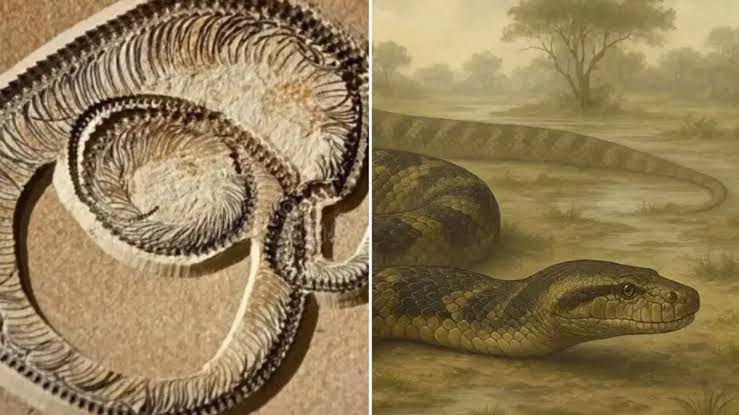
India’s prehistoric history is intriguing, and one of its most remarkable finds is a giant snake named Vasuki indicus that existed about 47 million years ago. This huge reptile was found as fossils in Gujarat and is believed to have been 11-15 metres long. It is thought to be one of the biggest snakes that ever lived on Earth. Here are some interesting facts about Vasuki indicus in 2026.
1. The origin of the Vasuki Indicus is dated to 47 million years ago
Vasuki indicus was a Middle Eocene (47 million years ago) animal. The Earth at this time was relatively warm, and large reptiles could have lived. The findings help shed light on the prehistoric creatures of India.
2. It may grow to be 15 metres long
The very interesting thing about Vasuki indicus is its tremendous estimated dimensions. Experts estimate that it grew to be about 11–15 metres (36–49 feet) long. This is about the length of a big bus and puts it in the ranks of the longest snakes in the world. This measurement is an estimate, however, based on fossils.
3. Fossil found in Gujarat
The fossils have been extracted from the Panandhro Lignite Mine located in the Kutch area in western India. Twenty-seven mainly very well-preserved vertebrae were identified, of which some are still attached. The relative length of the snake’s body could be estimated from these fossilised bones.
4. Scientists believe that it had a thick Body
The vertebrae suggest that Vasuki indicus most likely possessed a wide, cylindrical body. It was estimated that its body may have been about 44 centimetres wide. Despite being the remains of a powerful predator, scientists can’t draw all of the conclusions about its appearance from the fossils available.
5. It was once a member of an extinct family of Snake
Vasuki indicus was a member of a family of snakes that ceased to exist millions of years ago, called Madtsoiidae. The family members are found in countries like India, Africa, Europe, the Middle East, and other ancient countries. The fossil study allows for the understanding of snake evolution and animal distribution in prehistoric times.
6. This may have been a slow-moving predator
Vasuki indicus was likely a slow-moving ambush predator, scientists believe. Its body structure and similarities with large snakes living today suggest that the snake might have used constriction instead of venom to capture and kill its prey. However, the exact hunting behavior is still not well understood, as there is not a lot of direct evidence.
7. It Rivalled the Famous Titanoboa
Vasuki indicus is often compared to another gigantic prehistoric snake found in Colombia: Titanoboa. Both are believed to have extended to remarkable lengths and are of significance for studies of giant snakes. But it is not yet certain which was heavier or larger since there’s not enough fossil evidence available to say.
8. It is associated with Indian mythology
Vasuki indicus is culturally and geographically significant. Vasuki is the name of a mythical serpent king that is related to Lord Shiva in Hindu mythology; India is called Indic. The name highlights the discovery’s Indian origin and connects this remarkable prehistoric animal with the country’s cultural heritage.
Conclusion
Vasuki indicus is one of the most interesting prehistoric finds of India. It is scientifically significant due to its estimated size, its oldest fossils, and its association with the extinct Madtsoiidae family. In 2026, this enormous snake will still be a fascinating example of the diversity of life found on Earth millions of years ago, which is still being discovered through fossils.
About the Author