The Men Behind the Scoreboard: India’s Cricket Coaches Through the Decades
Cricket in India runs on heroes with a bat or ball in hand. Yet every partnership, every batting collapse turned into a chase, every trophy lift owes something to a figure standing quietly near the boundary rope: the coach. From 1971 right up to the present day, a long line of coaches has shaped the Indian team’s temperament, tactics, and eventually, its trophy cabinet.
A New Era Under Gautam Gambhir
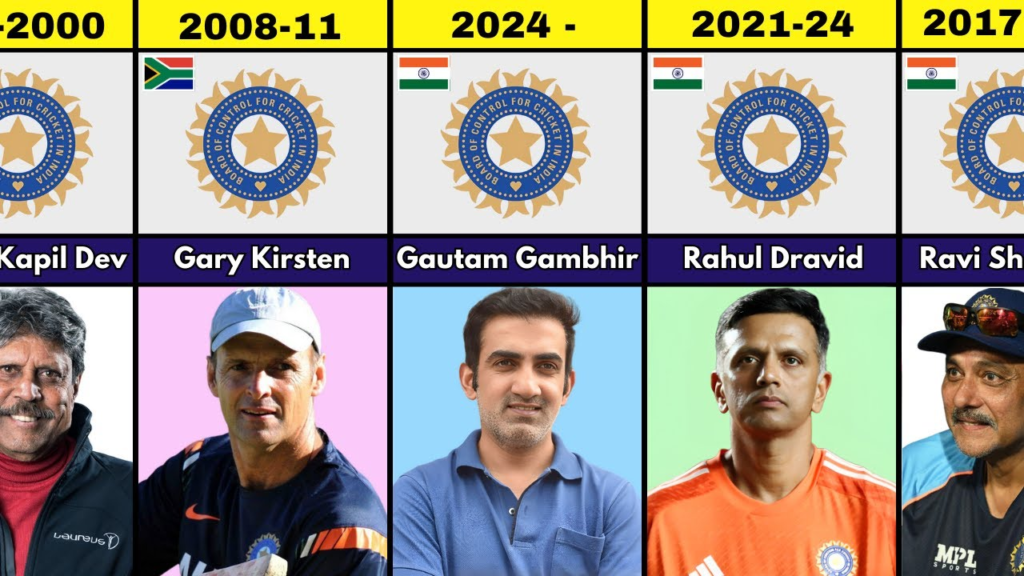
The current man in charge is Gautam Gambhir, a former opener known for his fierce competitiveness on the field. Since taking over in 2024, he has already delivered results that most coaches only dream of. Under his watch, India lifted the 2025 Asia Cup by getting the better of Pakistan, followed that up with a hard-fought 44-run win over New Zealand in Dubai to claim the 2025 ICC Champions Trophy India’s first in over a decade and then capped it off with a commanding 96-run victory against New Zealand in Ahmedabad to win the 2026 Men’s T20 World Cup. Three major titles in under two years is a rare feat, and it has quickly made Gambhir one of the most successful white-ball coaches the team has had.
The Coaches Who Built the Foundation
Long before Gambhir, a colourful cast of characters took turns guiding the side, each leaving a distinct fingerprint on Indian cricket.
Rahul Dravid, fondly remembered as a batsman for his unshakeable temperament, brought that same steadiness to coaching. His tenure produced a T20 World Cup and an Asia Cup, built on patience rather than flash.
Ravi Shastri, in contrast, coached with swagger. Backing his players fiercely and pushing an attacking brand of cricket, he oversaw some of India’s best overseas Test performances and served the team across three separate stints.
Anil Kumble’s time in charge was brief but firm no ICC silverware, but a perfect record in Test series during his tenure spoke volumes about the discipline he instilled.
Duncan Fletcher worked more behind the curtains, steadying a team through turbulence and still managing to deliver the 2013 Champions Trophy. Gary Kirsten, meanwhile, is often rated as one of the finest coaches India has had his calm, low-key style was central to India’s 2011 World Cup triumph.
Further back, Lalchand Rajput guided India to its first-ever T20 World Cup crown in 2007, while Greg Chappell’s stint, though remembered for friction with players, still produced strong bilateral series wins. John Wright made history simply by being India’s first overseas coach, guiding the team to a World Cup final in 2003. And cricketing legends like Kapil Dev and Anshuman Gaekwad also took their turns in the coach’s chair, contributing experience and mentorship even when trophies were scarce.
A Legacy Built by Many Hands
Looking at the complete list stretching from Keki Tarapore in 1971 through Hemu Adhikari, Ajit Wadekar, Madan Lal, and dozens of others, all the way to Gambhir today one thing becomes clear: Indian cricket’s success was never authored by a single individual. Every coach added a chapter, whether through silverware, hard lessons, or simply holding the dressing room together during difficult periods. Together, they form the quiet architecture behind Indian cricket’s rise to the top of the world game.
About the Author